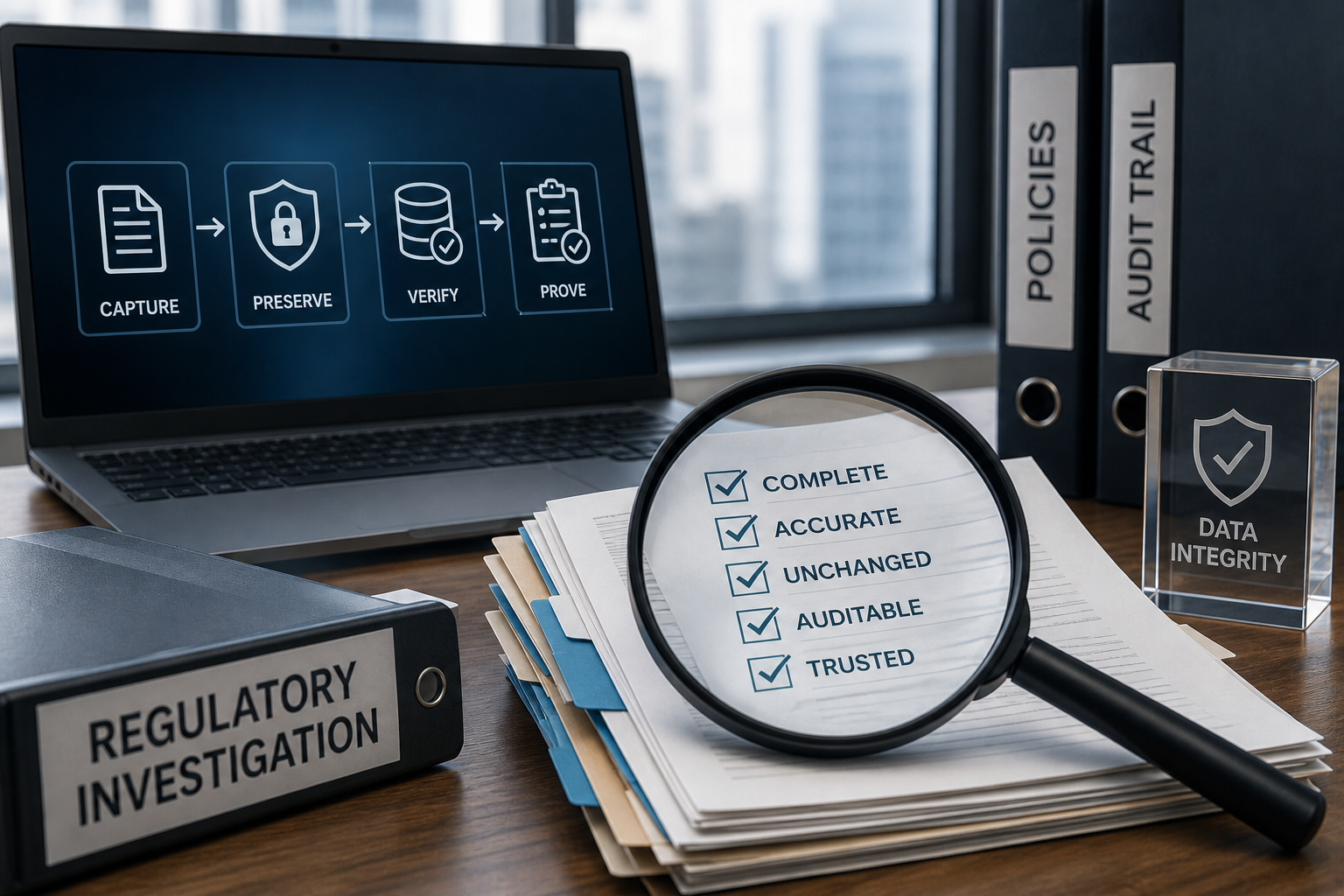
When a regulatory investigation begins, your organization must do more than produce information. You will need to prove that your data is complete and unchanged from its original form. Regulators want to understand how the data was created and preserved over time, and this is where many organizations struggle.
Without a clear understanding of how to prove data integrity during a regulatory investigation, it becomes difficult to show that your records reflect what actually happened. Building a defensible approach to data integrity compliance is critical if you want to avoid issues during an investigation.
What Does Data Integrity Mean in an Investigation?
Data integrity refers to the reliability and trustworthiness of your information. Knowing how to prove data integrity when regulators investigate your organization involves being able to answer basic questions with confidence. You should be able to demonstrate what your company communicated at a specific time and whether that content has changed since then. Regulators will want to see a clear history of edits or updates.
If you cannot answer these questions, regulators may question the validity of your data. That can shift attention away from the issue under review and toward your internal processes.
Why Data Integrity Is Harder To Prove Today
Modern business systems create challenges that did not exist in the past. Information is no longer static, as organizations use various tools and systems to communicate. Some documents and applications may have shared users and multiple versions, and you will need to retain all of that data.
Unfortunately, traditional recordkeeping methods do not always capture these changes. A simple snapshot or exported file may not reflect how the content appeared to users in real time. This gap makes it more difficult to demonstrate the integrity of your data during an investigation, especially when regulators expect a clear and accurate record of past communications.
What’s more, your organization could face a variety of regulators and regulatory frameworks depending on the sector you are in. Each of the following has its own expectations surrounding data preservation:
- Securities and Exchange Commission (SEC)
- Financial Industry Regulatory Authority (FINRA)
- Commodity Futures Trading Commission (CFTC)
- Department of Justice (DOJ)
It’s a good idea to collect and preserve data in a way that complies with each of these frameworks.
Key Elements of Data Integrity
Some important factors to consider when it comes to the integrity of your data include the following.
Consistent Data Capture
You need a reliable way to capture data as it is created or published. This includes websites, social media, and internal communications. The goal is to preserve content as it existed in specific moments, not after it has changed.
Preservation in Original Context
Data should be stored in a way that reflects how users experienced it. For example, a website should be preserved as a functioning page, not just as text or code. Context matters when regulators review communications.
Audit Trails
A defensible system tracks changes over time. You should be able to show when content was created, updated, or removed. This helps demonstrate that your records are complete and have not been altered improperly.
Centralized Access for Review
Your compliance teams need access to preserved data without relying on multiple departments. Centralized systems reduce the risk of losing information and make it easier to respond quickly to requests.
Implementing these measures is key to demonstrating data integrity during a regulatory investigation.
Common Gaps That Undermine Data Integrity
Even well-prepared organizations can face issues if their processes do not cover all data sources. One common gap involves public-facing content. Websites and social media often change quickly, and many organizations fail to capture every version, making it more difficult to demonstrate data integrity to regulators during an investigation.
Another gap appears in collaboration tools. Conversations and shared documents may contain key information, but organizations do not always preserve them in a structured way. If you overlook these systems, your data set may be incomplete.
When data integrity fails, the consequences can extend well beyond a difficult investigation. Regulators may impose fines if they determine that your organization failed to preserve required records or cannot produce complete and reliable information. If your organization is involved in litigation, the courts may also impose sanctions for failing to preserve electronically stored information appropriately. Depending on the circumstances, those sanctions can include monetary penalties, limitations on the evidence your organization may present, or adverse inference instructions.
Best Data Integrity Practices
Strong data integrity starts with consistent processes, not just reliable technology. When these practices are in place, it is much easier to demonstrate that your records are accurate and trustworthy. Some best practices include:
- Capture data directly from the source
- Preserve metadata with every record
- Maintain version history
- Apply consistent retention policies
- Issue legal holds promptly
- Restrict unauthorized changes
- Conduct regular compliance audits
- Train employees on data preservation
Following these practices helps create a defensible recordkeeping process that stands up to legal and regulatory scrutiny.
Learn How Hanzo Illuminate Helps Demonstrate Data Integrity During Regulatory Investigations
The right technology helps you move from reactive to proactive compliance. When evaluating a solution, you should look for tools that capture data as it appears, preserve it in its original form, and make it easy to review later.
Hanzo Illuminate is built to meet these needs. It captures and preserves internal corporate data across all channels, from email to Asana. Preserving this data in its original form is the best way to ensure you are able to fully comply with a regulatory investigation when the time comes. If you have questions about how to prove data integrity during a regulatory investigation, contact us to learn how Hanzo Illuminate can meet your needs.




 N/a
N/a