When a regulator asks what your fee disclosure said last March, or opposing counsel disputes what a product page promised, someone on the team usually opens the Wayback Machine first. It is free and goes back to 1996, so it often has a snapshot close to the date in question.
But a screenshot often falls short in an audit or in court, which is why legal and compliance teams look for a Wayback Machine alternative. Recordkeeping rules expect a firm to hold its own complete record of what it published, and courts expect web evidence to be authenticated. A public archive that captures pages on its own schedule, and that disclaims the accuracy of what it holds, was not built for either job.
What the Wayback Machine does well
The Internet Archive has been crawling the public web since 1996, and anyone can search the Wayback Machine for free. For early research, it is a fast way to confirm that a page existed, see roughly when its content changed, and recover an old URL to investigate. Anyone can also trigger a capture of a public page through its Save Page Now feature.
Courts have not treated Wayback captures consistently when they are offered as evidence. In Weinhoffer v. Davie Shoring, a buyer won an online auction for an offshore housing module in 2018 and then refused to pay. At trial, the seller offered a Wayback Machine snapshot of the auction terms, and the district court took judicial notice of it. In 2022, the Fifth Circuit reversed. It held that a private internet archive does not meet the FRE 201(b) standard of a source whose accuracy cannot reasonably be questioned, and it pointed to the Internet Archive’s terms of use, which disclaim any guarantee of accuracy (23 F.4th 579).
For legal and compliance teams, that makes the Wayback Machine a research tool. A source that disclaims its own accuracy is hard to defend once a regulator or opposing counsel challenges a capture. A page you may need to produce to a regulator or a court needs a capture your team controls and can authenticate.
Why the Wayback Machine is not enough for regulatory audits
Recordkeeping rules put the duty to retain published content on the firm itself. A public archive that captures pages on its own schedule cannot carry that duty for you.
What the rules require
- FINRA Rule 2210(b)(4) requires firms to keep retail and institutional communications under the retention requirements of SEA Rule 17a-4(b), along with the dates of first and, if applicable, last use. A public website seen by more than 25 retail investors counts as a retail communication.
- FINRA Rule 4511 requires books and records to be preserved in a format and media that comply with Rule 17a-4.
- SEC Rule 17a-4(f), as amended effective January 3, 2023, requires electronic records to be kept in WORM format or in a system with an audit trail that allows an altered or erased record to be re-created (FINRA).
- For investment advisers, Advisers Act Rule 204-2 requires a copy of each advertisement the adviser disseminates.
Where the Wayback Machine falls short
Capture timing. The Wayback Machine records a page when its crawlers happen to reach it. A fee page that changes on a Tuesday and again on a Thursday may appear once in the archive, or not at all. The first-use and last-use dates FINRA asks for depend on knowing when each version went live and when it came down, and irregular snapshots cannot establish either date.
Coverage. Client portals behind a login, pages personalized by location or user, content loaded by scripts, and social media posts are often missing or incomplete. Those are frequently the pages an exam request is about, such as the disclosure a client saw at account opening.
Removal. Site owners can ask the Internet Archive to exclude their pages, and the archive’s terms disclaim any guarantee of accuracy. A page can drop out of the archive between the day it was published and the day an examiner asks for it.
Audit trail and storage. Defending a record means showing who captured the page, when, and every action taken on it since. The Wayback Machine keeps no such log for your firm. A firm also cannot place a third party’s public archive on WORM storage or attach an audit trail to it, so the archive cannot serve as the firm’s own record under Rule 17a-4.
Why the Wayback Machine is not enough for eDiscovery
In litigation, a web capture has to hold up from the day the preservation duty attaches through production to the other side. The Wayback Machine was built as a public library, and that path exposes several gaps.
Preservation. Under FRCP 37(e), a court can order curative measures when electronically stored information that should have been preserved is lost because a party failed to take reasonable steps. If the court finds intent to deprive, it can presume the lost information was unfavorable or enter a default judgment. The duty to preserve starts when litigation is reasonably anticipated, so a team needs a capture on that day. Waiting for a crawler to revisit the page is a gamble.
Authentication. FRE 901 requires evidence that an item is what its proponent claims. Courts have treated Wayback captures inconsistently:
- In United States v. Gasperini, 894 F.3d 482 (2d Cir. 2018), captures came in after the Internet Archive’s office manager testified about how the archive preserves pages (Justia).
- In United States v. Bansal, 663 F.3d 634 (3d Cir. 2011), captures were admitted with a witness who testified about how the Wayback Machine works.
- In Luke’s Cataract & Laser Institute v. Sanderson (M.D. Fla. 2006), captures were excluded without an affidavit from someone at the Internet Archive with personal knowledge.
- In Weinhoffer v. Davie Shoring (5th Cir. 2022), the court held judicial notice of a Wayback capture was improper.
The common thread is that authentication depends on the Internet Archive’s own staff, and the Archive charges for affidavits (Journal). Your evidence then rests on a third party’s process, and on terms that disclaim its accuracy.
Self-authentication. FRE 902(13) and 902(14) let a party authenticate electronic records with a written certification instead of live testimony. Rule 902(14) covers data copied from a device, storage medium, or file and verified through a process of digital identification, such as a hash value. A Wayback capture comes with no hash or process certification tied to your matter.
Fidelity. Dropdowns, sliders, expandable text, and embedded video often fail to replay. When a resource is missing, the archive may fill it from a capture made on a different date, so one replayed page can mix content from several points in time.
Production. Discovery needs a capture that can be exported with its metadata and loaded into a review platform. Wayback printouts carry the archive’s banner and none of the capture metadata a reviewer or opposing expert would ask for.
Free Wayback Machine alternatives and how they compare
Most lists of sites like the Wayback Machine judge them on whether they can find a missing page. For legal and compliance work, the better test is whether the capture would survive an examiner’s request or an authentication challenge. Here is how the common free Internet Archive alternatives hold up.
- archive.today saves an on-demand snapshot of a public page, plus a screenshot.
- Where it helps: quick public capture of a page before it changes.
- Gap for legal and compliance work: every snapshot is public, it does not save in WARC format, and the service is run by an anonymous operator.
- Perma.cc creates permanent citation links to archived pages and is run by Harvard Law School Library.
- Where it helps: citations in briefs, opinions, and law reviews.
- Gap for legal and compliance work: it is free only for courts and academic users, while others get 10 trial links and then move to paid plans. It preserves only the targeted page.
- ArchiveWeb.page (Webrecorder) is a browser extension and desktop app that records pages as you browse.
- Where it helps: interactive pages, including ones you are signed into, exported as WARC or WACZ files.
- Gap for legal and compliance work: each capture depends on the person who ran it, with no scheduling, managed storage, or WORM retention.
- Library of Congress Web Archive holds curated collections of sites selected by Library staff.
- Where it helps: historical research on government and public affairs.
- Gap for legal and compliance work: you cannot request capture of your own pages or a counterparty’s.
- Browser screenshots and Save as PDF save an image or PDF of what is on screen.
- Where it helps: fast internal reference.
- Gap for legal and compliance work: they leave out the page source, interactive elements, and any hash tied to the moment of capture.
Screenshots vs. full web archives
A screenshot or PDF records an image of the page. A full web archive records the page source and the resources it loaded, so the page can be replayed and inspected later. That difference shows up in litigation: an opposing expert can ask what code produced a disclaimer or whether a dropdown held additional terms. A screenshot cannot answer those questions, and a WARC capture with a recorded hash can.
The free tools above are useful for research and one-off captures. None of them keeps a firm-controlled record with a hash recorded at the moment of capture, which is what regulatory audits and eDiscovery ask for.
What to look for in a Wayback Machine alternative
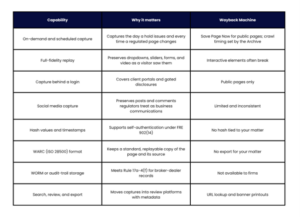
A Wayback Machine alternative for legal and compliance work should produce a record your team controls and can certify. These are the capabilities that close the gaps above, with how the Wayback Machine and Chronicle compare on each.
“Legal teams usually want to know one thing: will this capture hold up if someone challenges it? That depends on whether you captured the page at the right time, and whether you can prove it hasn’t changed since. A hash recorded at capture proves the second point. A screenshot taken afterward can’t.” – Dave Ruel, VP Product at Hanzo
Chronicle: A Wayback Machine alternative you control and can authenticate
Chronicle captures websites and social media on a schedule or on demand, so a team can preserve a page the day a legal hold issues and every time a regulated page changes. Each capture is preserved in WARC format on WORM storage, with a SHA-256 hash value and a timestamp.
Records you control. Chronicle’s WORM storage and hash values support records-retention rules such as SEC Rule 17a-4. The archive belongs to the firm, so a page cannot drop out because a third party received an exclusion request.
Evidence you can certify. The hash value recorded at capture gives litigation teams the digital identification that FRE 902(14) describes, so authentication does not depend on another organization’s staff.
Pages as visitors saw them. Chronicle replays captured pages, including sliders, dropdowns, and forms, from the preserved page source. A disclosure that sat inside an expandable section replays with that section working. Captures can also follow a visitor’s journey through a site, or show a page as it appears to visitors in a specific location.
Coverage at scale. United Airlines updates its website every weekday across several hundred pages owned by multiple departments, and its Chronicle archive lets the team revisit any page as it appeared on a given date. One investment management firm has archived 299.5 million pages with Chronicle over seven years of daily crawls.
Security. Chronicle is SOC 2 Type 2 certified, with support for customer-managed encryption keys.
“Most teams come to us after a request they couldn’t answer, usually an examiner or opposing counsel asking what a page said on a specific date. Once Chronicle captures on a schedule, that request becomes a lookup. The team opens the archive, finds the page as it appeared that day, and exports it with its hash and timestamp.” – Dave Ruel, VP Product at Hanzo
The Wayback Machine remains useful for early research. For any page your firm may need to produce to an examiner or a court, the capture should be your own.
FAQ
Is the Wayback Machine admissible in court?
Sometimes. Courts have admitted Wayback captures when an Internet Archive employee testified or submitted an affidavit about how the archive works, as in United States v. Gasperini (2d Cir. 2018). In Weinhoffer v. Davie Shoring (5th Cir. 2022), the court held that judicial notice of a capture was improper without that kind of authentication. The court also pointed to the Internet Archive’s terms of use, which disclaim any guarantee of accuracy.
Can I use the Wayback Machine for FINRA or SEC recordkeeping?
No. SEC Rule 17a-4 and FINRA Rule 2210(b)(4) require the firm to keep its own records of communications, including dates of first and last use, in WORM or audit-trail storage. A public archive the firm does not control cannot meet those conditions.
How do I prove what a website said on a specific date?
Capture the page at that time with a tool that records a hash value and a timestamp and stores the capture in WARC format. A certification under FRE 902(13) or 902(14) can then authenticate it without live testimony. If the date has already passed, a Wayback capture backed by an Internet Archive affidavit may be the best evidence available.
Are there free sites like the Wayback Machine?
Yes. archive.today saves on-demand public snapshots, and ArchiveWeb.page records pages in your own browser and exports WARC files. Perma.cc is free for courts and academic users. They work for research and citations, but none provides WORM storage or a hash recorded at capture for regulatory or litigation use.
What should a Wayback Machine alternative for legal teams include?
On-demand and scheduled capture, full-fidelity replay, hash values, WARC output, and WORM or audit-trail storage. Chronicle provides each of these, along with capture of social media and search across the archive.




 N/a